

There is a type of wrong answer that is far more dangerous than a wrong answer you can catch.
A wrong answer you can catch looks like this: you ask ChatGPT for the capital of Australia and it says Sydney. You know Sydney is wrong. You correct it. You move on. No real damage done.
But there is another category of wrong answer. One where you have no reason to doubt it. One where the model sounds certain, uses the right vocabulary, cites plausible context, and delivers something that feels credibly accurate. And the reason you cannot catch it is not because you are not paying attention. It is because the model itself has no mechanism, no internal alarm, no built-in signal, that would tell it something is missing.
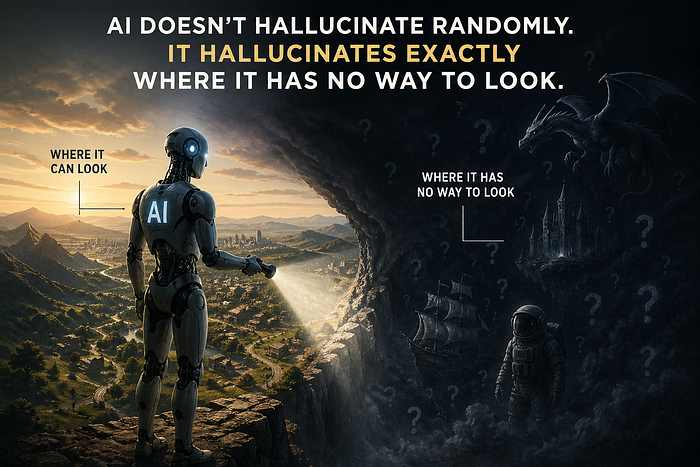
That second type of failure does not get discussed enough.
Everyone talks about AI hallucinations as if they are random glitches, like a television set with bad reception occasionally showing static. Fix the reception and the static goes away. But that framing misses the point entirely. The failures that should worry you most are not random. They follow a pattern. And that pattern traces back to a problem philosophers identified centuries before the first neural network existed.
It is called the homunculus problem.
Understanding it does not just explain why AI hallucinates. It explains why AI hallucinations are structurally unavoidable in exactly the places where you most need accuracy. And once you see it, you cannot unsee it.
The Tiny Man Inside Your Head (And Why He Ruins Everything)
Picture the following thought experiment.
You are looking at a red apple. Your eyes receive light. That light gets converted into signals. Those signals travel to your brain. Your brain processes them. And somewhere in that process, you experience the color red. You see the apple.
Now here is the question that drove philosophers absolutely mad for centuries: who is doing the seeing?
Your eyes do not see. They are receptors. Your optic nerves do not see. They are cables. Your visual cortex processes signals, but processing is not experiencing. So somewhere in there, something is watching. Something is receiving all that input and turning it into conscious experience.
The philosopher Rene Descartes imagined a small homunculus, a tiny person, sitting inside your brain watching the incoming images like a person watching a screen. That little person was the "real" you. The observer behind the observer.
Here is where the problem kicks in.
If there is a tiny person inside your head watching what you see, then that tiny person also has a brain. And inside that brain, there must be another tiny person watching what the first tiny person sees. And inside that brain, another. And another. Forever.
It never bottoms out.
The homunculus is an infinite regress. Every time you try to explain perception by putting a watcher inside the system, you just create a new system that needs another watcher. You never actually explain how perception works. You just push the mystery one level deeper each time.
This problem is not just about vision. It applies to any system that tries to evaluate itself using itself as the evaluator.
Which brings us directly to large language models.
How a 17th Century Brain Teaser Became a 21st Century Engineering Problem
A language model learns from data. Enormous amounts of it. Text scraped from the internet, books, academic papers, forums, news articles, scientific journals, legal documents, code repositories, social media. The model reads all of this, finds patterns in how words and concepts relate to each other, and builds an internal representation of the world.
That internal representation is its entire universe.
Everything the model "knows" is a compressed reflection of what existed in that training data. It has no access to the world outside that data. No sensory input. No lived experience. No ongoing stream of new information once training ends. Just the patterns it built from a fixed snapshot of human text.
Now ask yourself: how does that model know what is missing from its training data?
It cannot check. There is no watcher inside the model scanning for gaps. There is no alarm that fires when a question touches a domain that was underrepresented or absent. The model processes your input using the patterns it has, generates an output that fits those patterns, and returns it with the same confident delivery it uses for everything else.
The model cannot observe its own blind spots for the same reason you cannot see the back of your own head without a mirror. The thing doing the looking is also the thing with the blind spot.
This is the homunculus problem applied to AI. You cannot solve the problem of self-evaluation by adding more of the same kind of system. A language model checking its own outputs is just the same model, using the same weights, looking at the same patterns. It cannot see what is absent because absent things leave no pattern to detect.
And absent things are everywhere.
The Training Data You Never Think About
Here is a number worth sitting with: roughly 56% of all internet content is in English. That sounds fine if you are reading this in English. But consider what it means for the other 7,000-plus languages spoken by humans on this planet.
A model trained on the internet is, structurally, a model trained mostly on the perspective of English-speaking populations. Not because anyone made a deliberate choice to exclude other languages or cultures. But because that is what the data contains. The model does not know Hausa proverbs the way it knows English idioms. It does not have the depth of understanding of social dynamics in rural Maharashtra that it has for Silicon Valley startup culture. It does not carry the oral traditions of indigenous communities that were never written down in digitized form.
That absence is invisible to the model. There is no flag that says "warning: insufficient training data from this region." When you ask the model about something touching on those gaps, it does not hesitate. It generates something. Something that fits the patterns it has. Something that sounds coherent. And something that may be missing entire layers of context that someone from that community would immediately recognize as off.
But it gets more specific than geography and language.
Think about what kind of text gets written and published online in large volumes. Technical documentation. Opinion journalism. Academic research abstracts. Social media posts from people who have smartphones, internet access, and time to type. Business communications. Fiction from published authors.
Think about what does not get written in large volumes. The daily experience of a subsistence farmer in a region with limited internet access. The specialized knowledge held by master craftspeople who learned from watching rather than reading. The medical presentations of diseases that primarily affect populations underrepresented in clinical research. The legal customs and community structures that exist entirely outside formal written systems.
The model's world is built from what people wrote down and what survived to be scraped. The rest of human experience is simply not there.
Here is the part that should make you uncomfortable.
The model does not treat questions about well-documented domains differently from questions about underdocumented domains. The confidence level does not noticeably shift. The response structure stays the same. You get a complete-sounding answer either way.
This is not a bug that can be patched with better prompting. It is architectural.
What Donald Rumsfeld Got Right (Even If He Got Other Things Very Wrong)
In 2002, then-US Secretary of Defense Donald Rumsfeld gave a press briefing that produced one of the most accidentally useful frameworks in epistemology. He was talking about military intelligence, but the structure applies everywhere.
He said:
There are known knowns. Things we know we know. There are known unknowns. Things we know we don't know. And there are unknown unknowns. Things we don't know we don't know.
People mocked this at the time. It became a meme. Journalists called it baffling. But strip away the context and the framework is genuinely useful. Especially when you apply it to AI.
Known knowns. The model knows the capital of France is Paris. It knows how to write a Python function. It knows the plot of Hamlet. These are things it was trained on extensively, from multiple angles, in multiple contexts. It handles them reliably. When you ask about known knowns, the model performs well.
Known unknowns. These are gaps the model can sometimes detect. Ask it about events after its training cutoff and a well-calibrated model will tell you it does not have that information. Ask it for real-time stock prices and it will acknowledge it cannot provide them. Ask it for your neighbor's phone number and it will tell you it does not have access to personal data. These are known boundaries. The model can point at them.
Here is where it gets uncomfortable.
Unknown unknowns. These are the gaps that cannot be detected because the model has no framework for knowing that the gap exists. These are the questions where the model will confidently give you an answer because nothing in its pattern library says "stop, something is missing here."
These are also the most dangerous.
An unknown unknown is not a question the model gets wrong because it tried and failed. It is a question the model gets wrong because it successfully generated a pattern-matching response from insufficient or absent data, with no internal signal that anything was amiss.
The model cannot map its own unknown unknowns. That would require a watcher. And the watcher would need a watcher. The regress never ends.
When This Stops Being Abstract: The Real-World Failures That Matter
Let me be specific. Because this stops being philosophy the moment real decisions get made based on AI outputs.
Medicine: The Diagnosis That Fits the Data You Have
In 2023, researchers at Stanford published a study examining how large language models performed on clinical reasoning tasks. The models did well on standard cases. Cases that looked like textbook examples. Cases that matched the dominant patterns in medical literature.
They did significantly worse on atypical presentations. Cases where the disease presented differently from the majority of documented cases. Cases that were more common in populations underrepresented in clinical research.
This matters enormously because medical knowledge has its own representation gaps. The vast majority of clinical trials have historically enrolled predominantly white male participants. Drug dosing, symptom profiles, and risk factors have been documented primarily through that lens. For decades.
When a doctor in a clinic uses an AI diagnostic tool and that tool was trained on medical literature reflecting those representation gaps, the tool is not just guessing. It is confidently pattern-matching from a biased sample. And it has no way to flag that the patient in front of it might present differently from what the training data described.
The model does not know what it does not know about that patient population.
A wrong diagnosis that presents with low confidence gets checked. A wrong diagnosis that presents with high confidence gets followed.
That is the real danger.
Law: The Precedent That Was Never There
In 2023, two lawyers in New York filed a brief that cited six legal cases as precedents. All six cases were fabricated. They did not exist. The AI system they used had generated plausible-sounding case names, plausible-sounding rulings, and plausible-sounding legal reasoning. None of it was real.
The lawyers were sanctioned. The story became famous as a cautionary tale about AI hallucination.
But the more interesting version of this problem is quieter and harder to catch.
Legal systems outside the major Anglo-American tradition are systematically underrepresented in AI training data. Civil law systems. Customary law systems. Hybrid legal systems across Africa, Southeast Asia, and Latin America. The documentation of these systems in English-language text is sparse compared to the documentation of US or UK common law.
Ask an AI about a nuanced point of US contract law and it draws from a deep well. Ask it about the same type of dispute under a customary land tenure system in a specific region of Sub-Saharan Africa and it will still give you an answer. Still confident. Still structured like legal reasoning. And potentially missing layers of context that would be immediately obvious to a practicing lawyer in that jurisdiction.
The model does not hesitate at the edge of its competence. That edge is invisible to it.
Culture: The Meaning That Gets Stripped Out
Here is a smaller example but a telling one.
Humor does not translate cleanly across cultures. Not because the concepts are untranslatable, but because humor relies on shared context, shared tensions, shared assumptions about what is normal and what violates that norm. A joke that lands in one context requires the audience to share a specific cultural background.
AI language models are reasonably good at generating humor in English-speaking cultural contexts. They have a deep training base for this. They understand timing, subversion of expectation, callback structure.
Ask a model to write humor for a specific cultural context it has limited training data for and something subtle happens. The output looks like humor. It has the structure of humor. But it might miss the specific cultural nerve that makes a joke actually funny to that audience. And the model will not flag this. It does not know what cultural nerve it is missing. It just generates the closest pattern-match it has.
Now scale this up to anything that requires genuine cultural insider knowledge. Marketing campaigns. Healthcare communication strategies. Educational materials. Policy documents meant for specific communities.
The outputs can look right. The gaps are only visible to the people whose knowledge is absent.
Policy: The Feedback Loop Nobody Notices
This one is perhaps the most systemic of all.
When government agencies, nonprofits, or international organizations use AI tools to analyze data and generate policy recommendations, those tools are drawing on training data that reflects the status quo. What has been written. What has been studied. What has been documented.
The populations most in need of good policy are often the least documented. They have fewer research papers written about them. Less data collected on them. Less representation in the institutional text that gets scraped into training sets.
An AI system analyzing urban poverty will have better quality data on urban poverty in well-studied cities than in cities with less research infrastructure. It will generate more confident recommendations for the contexts it knows. And it will still generate recommendations for the contexts it does not know, because nothing in the system tells it to hesitate at the boundary.
The unknown unknowns do not announce themselves. They just produce confident outputs.
The Confidence Mask: Why "I Don't Know" Is Rarer Than It Should Be
This is the part people resist most. Because we have all seen AI systems say "I don't know." We have all seen them decline to answer. We have all seen them express uncertainty.
So the claim that AI systems cannot detect their own blind spots seems obviously wrong. Right?
Not quite.
What language models are good at is detecting the known unknowns. The cases where the training data explicitly discussed its own limits. Post-cutoff dates. Real-time information. Personal data. These are the cases where uncertainty was well-represented in the training text. The model learned to express uncertainty about these things because humans writing about AI discussed these specific limitations extensively.
The unknown unknowns are different. There is no training signal that says "express uncertainty when the domain is underrepresented in your training data." The model cannot detect underrepresentation from the inside. It can only see what is there, not what is absent.
Think about it this way. If you spent your entire life in one city and never traveled, you would know a great deal about that city. You would not know what you were missing about other cities, because you have no reference for what you have not experienced. But more importantly, when someone asked you about another city, you would not necessarily know that your answer was thin. You might draw on partial information and feel reasonably confident.
Now imagine that person has the fluency and polish of a seasoned travel writer regardless of how thin their actual knowledge is. That is closer to what is happening with language models.
The surface presentation of an answer does not encode the depth of training data behind it. A response to a question about a well-documented topic and a response to a question about a poorly-documented topic look the same from the outside. Same structure. Same confident tone. Same complete paragraph format.
There is a term in psychology called the Dunning-Kruger effect: the tendency for people with limited knowledge in a domain to overestimate their competence. The mechanism is similar. Without enough knowledge to know what you are missing, you cannot calibrate your confidence accurately.
For AI systems, this is not a cognitive bias in the human sense. It is an architectural feature. The model generates the most likely next token given the context. It does not have a layer that says "but check if the domain is well-represented first." That check would require, you guessed it, a watcher.
The homunculus.
Which does not exist.
The Confidence-Calibration Gap: Specific and Measurable
Researchers have been studying something called calibration in AI systems. A well-calibrated model should express high confidence when it is likely to be correct and low confidence when it is likely to be wrong. The confidence score should track the actual accuracy rate.
The findings are consistent across multiple studies. Current large language models are overconfident in domains with sparse training data. They are reasonably well-calibrated in domains with dense training data. And the gap between expressed confidence and actual accuracy is widest precisely in the places where underrepresentation is highest.
This is not a failure of the models being studied. It is a predictable result of how these systems are built. You cannot train a model to be uncertain about what it does not know if the training data does not contain examples of that specific type of uncertainty.
And here is the sharpest edge of this problem.
The users who are most likely to be affected by failures in underrepresented domains are also the users who are least likely to have the background knowledge to catch those failures. A physician in the US reviewing an AI-generated clinical suggestion has enough context to push back when something seems off. A community health worker in a region where the tool was not calibrated for local disease patterns may not. A senior lawyer reviewing an AI-generated legal brief can catch fabricated citations. A non-specialist using an AI tool for community legal advice may not have the training to know what to question.
The blind spot falls hardest on the people who most need the tool to be reliable.
What This Actually Means If You Use AI Tools Every Day
Let me be direct about what this means practically. Not as a theoretical concern. Not as a future risk. But right now, in the way most people are using these tools.
The tool is not uniformly reliable across all topics. This sounds obvious when you say it out loud. But most people use AI tools as if reliability is uniform. As if a confident answer in one domain means you can trust a confident answer in any domain with the same degree of confidence. That is not accurate.
The tool is more reliable where the training data was dense, recent, and diverse. It is less reliable where the training data was sparse, dated, or homogeneous. And the tool cannot tell you which situation you are in.
The things you cannot verify are where the risk concentrates. If you ask AI to help you write an email and you can read the email and judge it, the downside of any errors is bounded. You are in the loop. If you ask AI to generate a recommendation about something you do not already know enough to evaluate, you lose that check. The unknown unknowns land in your hands still wrapped in confident prose.
The people most confidently using these tools in high-stakes domains should probably be most worried. There is a version of AI adoption where everyone is appropriately skeptical and double-checks important outputs. There is a version where early adopters in a domain enthusiastically automate decisions because the tool seems to perform well on the familiar cases. The second version is where the structural blind spots cause the most damage. Precisely because the familiar cases go so well, the unfamiliar ones get the same treatment.
"It gave me a detailed answer" is not the same as "it gave me an accurate answer." These two things feel like the same thing when you are not an expert in the domain. Length, structure, and specificity all read like confidence signals even when they are not accuracy signals. Learning to separate those two things is one of the most valuable skills you can develop as an AI user right now.
The Homunculus Problem Does Not Have a Clean Solution
I want to be honest about this part. Because a lot of AI coverage follows a specific narrative arc: here is a problem, here is the solution, here is your call to action. This problem does not work that way.
The homunculus regress was never solved in philosophy. It was dissolved. Philosophers eventually stopped asking "who is the observer inside the observer" and started asking different questions about how cognition works at the physical level. The problem did not get an answer. The framing of the problem got replaced.
Something similar needs to happen with AI self-evaluation.
Trying to solve AI blind spots by training models to express more uncertainty runs into the same regress. You need a model that knows when it does not know. To know when it does not know, it needs to evaluate its own knowledge. To evaluate its own knowledge accurately in sparse domains, it needs to know what those domains are. To know what those domains are, it needs the very knowledge it lacks. The regress does not bottom out.
Researchers are working on approaches that sidestep the regress rather than solving it directly. External knowledge grounding, where models retrieve information from verified sources rather than relying on internal weights. Structured uncertainty annotation, where human experts flag the domains where model confidence should be explicitly reduced. Red-teaming programs specifically designed to find failures in underrepresented populations. Diversity-aware training pipelines that deliberately oversample sparse domains.
These approaches help. They genuinely reduce the AI hallucination blind spots in specific domains. But none of them eliminate the structural problem. They cannot. The architecture of a system trained on text has an inherent gap at its center: the absence of a watcher that can see the watching.
What they can do is reduce the radius of the blind spot. Make the confident failures rarer. Push the edge of reliable performance further out. That matters. It matters a lot.
But the edge still exists. And the edge is still invisible from the inside.
The Specific Situations Where You Should Trust AI Less Than You Do Right Now
I am going to get concrete here. Not because I want to be alarmist. But because the alternative is a vague concern that people file away and never act on.
Medical information for rare conditions. Rare diseases are, by definition, rare. There is less written about them. The training data is thinner. The model will still give you a detailed answer about a rare condition. The answer may be accurate. It may also be confidently wrong in ways that neither you nor the model can easily detect without specialist input.
Legal advice outside major jurisdictions. English-language legal resources are abundant. Translate that advice into a different legal system and the depth of the training data drops sharply. The model does not bracket its legal answers by jurisdiction unless you push it to. Default to a specialist when the jurisdiction matters.
Cultural context for communities not well-represented online. If you are creating content, communication materials, or research for a community that has historically been underrepresented in internet text, treat AI outputs as rough drafts that require review from someone with actual community knowledge. Not as finished outputs.
Historical information about marginalized groups. The written historical record is not neutral. It reflects who had access to writing and publishing. AI-generated history skews toward the perspectives that were documented. This is not a subtle bias. It is a structural one.
Technical information about recent developments. Models have training cutoffs. After those cutoffs, the data goes sparse and then disappears. A model trained with data through a certain date does not progressively lose confidence as questions approach that date. The cliff is sharper than users expect.
Anything you cannot verify independently. This is the meta-rule. The risk of AI hallucination blind spots is highest when you have no way to check the output. If you are an expert in the domain, you have that check. If you are not, you need either an expert review or you need to hold the output as provisional until it can be verified.
Practical Things That Actually Help
Despite everything above, there are real practices that shift the risk profile meaningfully. None of them are magic. All of them require some effort. But they are concrete.
Push the model to flag its own uncertainty explicitly. Add this to your prompts: "If you are not confident in any part of this answer, flag it explicitly rather than smoothing over it." This does not solve the unknown unknowns problem. The model still cannot detect what it does not know. But it can sometimes surface the known unknowns more explicitly if you ask.
Ask follow-up questions designed to find the edge. Rather than accepting a confident answer, ask: "What are the limitations of this answer? What context would change it? What would a skeptic say?" This can sometimes reveal where the training data was thin. Not always. But sometimes.
Use AI more for structure and less for substance in high-stakes domains. AI is genuinely good at organizing information, formatting outputs, and identifying the right questions to ask. Those are lower-risk uses. The risk concentrates when AI is providing the substantive content itself in domains where you cannot verify it.
Build verification into your workflow, not as a backup but as a step. The most dangerous AI users are the ones who treat AI as the output, with human review as an optional final check. Reverse this. Treat AI as a draft generator and verification as the non-optional step. Especially when the stakes are high.
Know the data diet of the tool you are using. Not all models are trained the same way. Some are specifically fine-tuned on medical data. Some have better coverage of non-English sources. Some have more recent training cutoffs. Understanding the specific training provenance of the tool you are using helps you map where its blind spots are more likely to cluster.
Treat expressed confidence as a surface-level signal, not a ground truth. Confident prose means the model had enough pattern material to generate a structured response. It does not mean the response is accurate. This is uncomfortable to internalize because confident writing feels reliable. But separating those two signals is genuinely important.
The Deeper Thing This Reveals About How We Think About AI
Here is where I want to step back from the practical and say something that I think gets missed in most AI coverage.
We have built a cultural habit of evaluating AI on its best-case performance. When AI writes a beautiful piece of code, or generates a nuanced essay, or solves a complex reasoning problem, those cases get shared, celebrated, and used as evidence of what the technology can do.
The failures that come from AI hallucination blind spots do not get the same attention. They are harder to notice. They do not make for good demos. And they disproportionately affect the people who are least able to push back and demand corrections. The communities whose knowledge is most absent from training data are also the communities with least power in the institutions making decisions based on AI outputs.
This is not an argument against AI. It is an argument for a more honest accounting of what these systems actually are.
A language model is a reflection of the text it was trained on. It is not a neutral oracle. It does not have access to knowledge that was never written down or was never digitized or was never in the dominant training languages. Its confidence is not correlated with its accuracy in the way human expertise is. And it has no mechanism to flag the specific situations where that gap is widest.
The homunculus sits at the center of the system, invisible, unreachable, impossible to instantiate. Every attempt to make the model evaluate itself bottoms out in the same regress. The watcher needs a watcher. The check needs to be checked.
This does not make the tools useless. It makes the framing around the tools wrong. The tools are powerful and genuinely useful for enormous categories of tasks. And they have a structural blind spot that is not random noise but a predictable, architectural feature that concentrates failures in specific, often vulnerable places.
Both of those things are true. Holding both at the same time is harder than picking one. But it is more accurate.
The homunculus problem is not an exotic philosophical curiosity. It is a precise description of why current AI systems fail where they fail and why those failures are so hard to detect.
AI does not hallucinate randomly. It hallucinate with greatest probability at the boundaries of its training data, where patterns are thin, where coverage is sparse, where entire domains of human experience were never written down in forms that got into the training set. And at those boundaries, the model's expressed confidence does not fall. There is no internal watcher to see the edge.
This is not a problem that will be fully solved with the next model release. Some of the gap will narrow. The radius of the blind spot will shrink. But the architecture of these systems means the gap will persist, in some form, for the foreseeable future.
My honest view: the most important skill for anyone using AI tools in serious contexts right now is not prompt engineering. It is not knowing how to use the right model for the right task. It is calibrating your trust relative to your ability to verify. If you can check the output, the risk is bounded. If you cannot check the output, you are trusting a system that cannot tell you how much you should trust it in this specific case.
The homunculus has no voice. And it cannot tell you when it matters most.
I am curious where you have run into this specifically. Have you caught an AI being confidently wrong in a domain where you had the expertise to spot it? What did the failure look like? Drop it in the comments. The patterns people are finding in the real world are more informative than any benchmark study.
If this article was useful, consider following for more pieces on AI limitations, practical AI use, and the gap between how these tools are marketed and how they actually work.

This story is published on Generative AI. Connect with us on LinkedIn and follow Zeniteq to stay in the loop with the latest AI stories.
Subscribe to our newsletter and YouTube channel to stay updated with the latest news and updates on generative AI. Let's shape the future of AI together!
