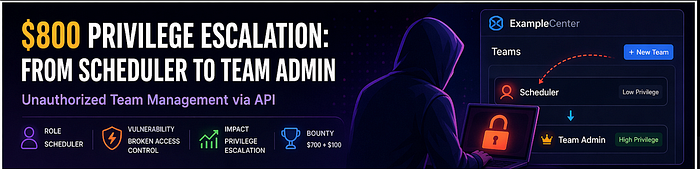


Hi Everyone! I recently discovered a Broken Access Control / Privilege Escalation vulnerability in a SaaS platform (ExampleCenter) that allowed a low-privileged user (Scheduler role) to perform editor-level administrative actions via direct API calls.
For this discovery, I was awarded a $700 bounty along with a $100 bonus for retesting. Let's explore how this bug worked, how I exploited it, and why it was important.
Understanding the Target
ExampleCenter is a SaaS platform used for managing teams, scheduling, and workflows within organizations. It follows a role-based access control model:
- Editors/Admins → Can manage teams, structure, and permissions
- Schedulers → Can only assign people to existing teams
To maintain proper security boundaries, only Editors and Admin should be able to:
- Create teams
- Copy teams
- Assign team leaders
- Modify team configurations
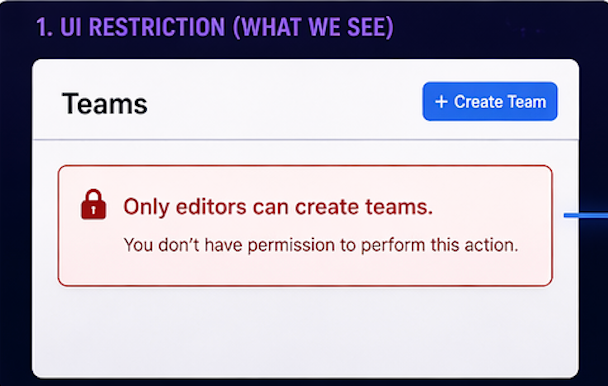
The UI correctly enforces this restriction by displaying:
"Only editors can create teams."
At this point, everything looked correct.
But from experience, I've learned one important thing:
If something is blocked in the UI… it doesn't mean it's blocked in the backend.
The Moment of Curiosity
Instead of stopping there, I opened Burp and started looking at how the application was communicating with the backend.
I noticed that when switching tabs or loading team-related data, the app was calling certain API endpoints. That gave me an idea:
What if the team creation functionality still exists in the API, but is just hidden in the UI?
So I decided to test it manually by accessing the team creation api from higher level user account and use via scheduler user.
The Flaw: Backend Didn't Enforce Authorization
I crafted a request to the team creation endpoint using my Scheduler account token:
POST /api/services/v2/service_types/{id}/teams HTTP/2
Host: api.examplecenter.com
Authorization: Bearer <scheduler_token>
Content-Type: application/json

{
  "data": {
    "type": "team",
    "attributes": {
      "name": "SchedulerTeam",
      "copy_team_members": true,
      "secure_team": true,
      "team_leader_ids": [attacker_id]
    }
  }
}
I honestly expected a 403 Forbidden.
But instead…
👉 200 OK — Team Created Successfully
Not only that:
- The team was created
- I was assigned as Team Leader
At that moment, it was clear:
This wasn't just a UI issue — this was a full authorization bypass.
Going Deeper: How Far Can This Go?
Once I confirmed the initial bug, I started exploring how much control I actually had.
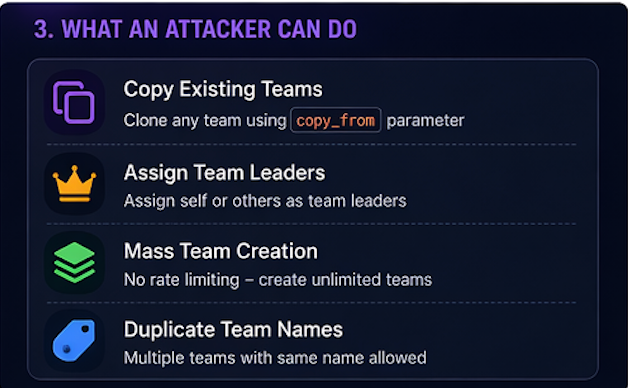
1. Copy Existing Teams
I noticed a parameter:
"copy_from": "<team_id>"So I tried cloning an existing team.
👉 Result:
- Full team structure copied
- Members and configurations inherited
- I could assign myself as leader
This turned the bug from simple bypass → structured privilege escalation
2. Assigning Leadership
By modifying:
"team_leader_ids": [my_user_id]I could:
- Assign myself as leader
- Assign other users as leaders
👉 Basically controlling hierarchy inside the system
3. Mass Team Creation
Then I tested limits…
- No rate limiting
- No restrictions
👉 I could create hundreds of teams quickly
This could:
- Flood the system
- Break workflows
- Create administrative chaos
4. Duplicate Team Names
Another small but interesting issue:
- Same team name allowed multiple times
- No uniqueness validation
👉 Leads to confusion + potential misuse
Root Cause
This bug came down to one classic mistake:
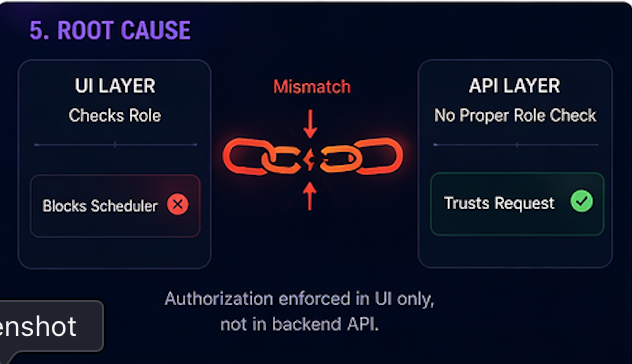
Authorization was enforced only in the UI, not in the backend API
- UI → correctly restricts Scheduler
- API → blindly accepts request
This mismatch is exactly where most BAC (Broken Access Control) bugs live.
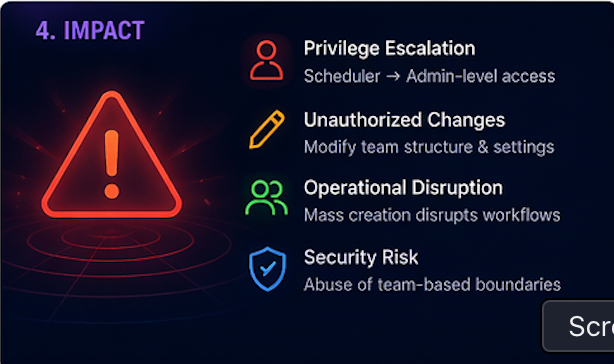
Impact
This wasn't just theoretical it had real-world implications:
Security Impact
- Privilege escalation (Scheduler → Admin-like control)
- Unauthorized structural changes
- Self-assigned leadership roles
Operational Impact
- Mass team creation → workflow disruption
- Duplicate teams → confusion
- Increased cleanup overhead
Business Risk
- Breaks trust in role-based permissions
- Violates least privilege principle
- Could enable misuse or internal abuse
Bounty & Program Response
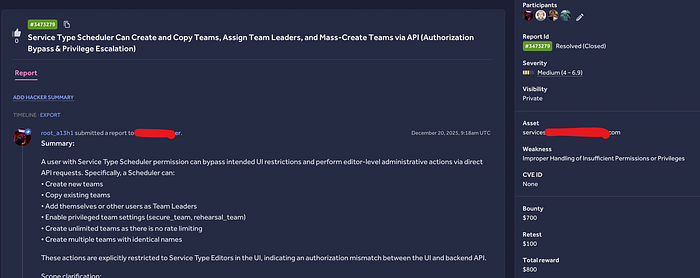
- Reported: Dec 20, 2025
- Triaged: Jan 5, 2026
- Severity: High → Medium
- Bounty: $700 + $100 bonus
- Retest: Fix confirmed (API now returns 403)
Key Takeaways
- Never trust UI restrictions always test the API
- Backend authorization is the real security layer
- Privilege escalation often hides in: Create , Copy ND Assign operations
- Missing rate limits can amplify impact
- Observing API calls / JS endpoints can reveal hidden attack surfaces
Conclusion
This bug is a perfect example of how frontend restrictions can create a false sense of security.
From the UI, everything looked secure.
But under the hood, the API allowed a low-privileged user to perform admin-level actions.
These kinds of vulnerabilities are extremely common in modern SaaS platforms — especially where complex role systems exist.
As a hunter, always ask:
👉 "What if the backend doesn't care?"
Until next time — happy hacking! 🚀
Connect and Engage
💬 What's your experience with PE bugs?
Follow me on Twitter: @a13h1_
Keep clapping, commenting, and sharing your thoughts — your support motivates me to share more real bug bounty stories!