

Prodigy · Quantum Physics · Human Enhancement
Laurent Simons is 15. His PhD thesis explored Bose polarons in ultracold quantum matter at the University of Antwerp. His next thesis is titled: "Creating a superhuman by defeating aging." Most of us are still figuring out algebra.


When I was 8 years old, I was learning to read Tamil and figuring out long division. Laurent Simons was finishing high school. When I was 11, I was navigating the social minefield of middle school. Laurent Simons had just become the world's youngest university graduate, having completed a three-year bachelor's degree in physics in eighteen months. When I was 12, I was discovering cricket. He had completed a master's in quantum physics. He is currently 15. He holds a PhD.
These are not comparisons designed to make either of us feel inadequate they are data points that reveal something genuinely extraordinary about one human mind and its relationship to the systems we've built to credential knowledge. Laurent Simons didn't just move fast through the curriculum. He moved through it at a pace that suggests he was constrained by it, not defined by it. The institutions kept confirming what was already obvious.
On November 17, 2025, the University of Antwerp publicly confirmed the successful defense of his doctoral dissertation in theoretical physics. The thesis "Bose polarons in superfluids and supersolids" was submitted through conventional academic channels, reviewed by standard committees, and validated under the same requirements any doctoral candidate faces. No special provisions for his age. No accelerated certification. The same finish line, reached decades early. He is now in Munich, pursuing a second PhD in medical science and artificial intelligence, with a stated goal he has articulated publicly on Belgian national television: to create superhumans.
Let's take that seriously both the achievement and the ambition.

The phrase "quantum physics PhD at 15" is extraordinary enough that most coverage stops there. But the actual content of Laurent's doctoral research is worth understanding, because it reveals a mind that wasn't just moving fast, but moving deep.
His dissertation examined Bose polarons in superfluids and supersolids. To understand why this matters, you need to understand what a Bose-Einstein condensate is. When certain atoms are cooled to temperatures within billionths of a degree of absolute zero temperatures colder than the vacuum of space they collapse into a single quantum state where all the atoms behave as one coherent entity. This fifth state of matter, predicted by Albert Einstein and Satyendra Nath Bose in the 1920s and first experimentally achieved in 1995, is one of the most exotic and theoretically rich phenomena in all of physics. It's a quantum simulator a controlled system where quantum mechanical phenomena can be studied in ways impossible with conventional matter.
Within this condensate, Laurent studied polarons impurity particles that interact with the surrounding quantum medium and acquire an effective mass and energy different from their bare properties. As a quasiparticle, the polaron "dresses" itself with excitations of the surrounding medium as it moves through it. Laurent specifically examined how polarons behave in two different exotic quantum states: superfluids (which flow without viscosity) and supersolids (which simultaneously exhibit crystal-like order and superfluid flow a state only first confirmed experimentally in 2019). His work calculated the behaviour of these quantum quasiparticles using advanced theoretical methods, contributing to the foundational understanding of many-body quantum systems.
This is not introductory physics. This is the frontier the domain where Nobel laureates spend decades and still sometimes get surprised. Laurent Simons completed doctoral-level research in this domain at an age when most physics students are just beginning to understand calculus. His PhD supervisors professors Jacques Tempere and Michiel Wouters at Antwerp are leading researchers in the field. They guided the work as supervisors do, but the research contribution is real and documented in peer-reviewed preprints.

Laurent's trajectory is not simply the story of exceptional natural intelligence though that intelligence is clearly real and extraordinary. It is also the story of an environment that chose, at every stage, to accelerate rather than hold back.
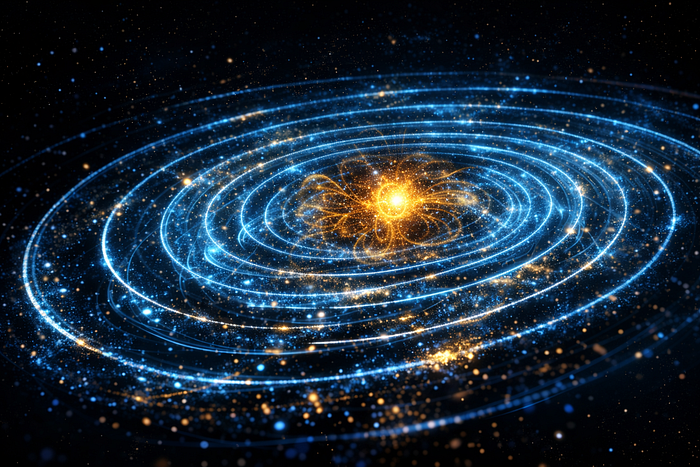
He started primary school at four two years ahead of the standard age. By six, he had finished. By eight, he had completed high school. His parents describe him as having a photographic memory and an IQ of 145 a level reached by approximately 0.1% of the global population. But raw intelligence alone does not produce a PhD at 15. It requires institutional willingness to admit a child into university, supervisor willingness to guide doctoral research, and family willingness to navigate an entirely unconventional path while also ensuring there's still "the boy" alongside the scientist.
His father told a reporter in 2022: "There are two Laurents the scientist and the boy." That distinction matters. The prodigy narrative in the media tends to collapse the two to see only the credentials and miss the person accumulating them. Laurent has spoken publicly about losing his grandparents at age 11 and deciding, in the aftermath of that loss, that his goal would be immortality or at least its extension. "It's not for myself," he has said. "It's for others." The scientific ambition is rooted in something recognizably human: grief, love, and the refusal to accept what is presented as inevitable.
He completed his bachelor's degree at the University of Antwerp in 18 months, a program designed for three years. He then completed his master's degree at 12, with a thesis on Hawking radiation and Bose-Einstein condensates work that connected two of the most profound theoretical constructs in modern physics. He conducted an internship at the Max Planck Institute for Quantum Optics in Germany, contributing to quasiparticle research in ultracold atomic environments. He then returned to Antwerp for his PhD, defended in November 2025, and relocated to Munich to begin again.

The phrase "creating superhumans" sounds like science fiction. As a scientific research agenda, it is more nuanced and more serious than the headline suggests.
Laurent's second PhD is in medical science with a specialization in artificial intelligence at the University of Munich. His stated thesis direction involves using AI to understand and intervene in complex biological systems particularly in the context of aging and longevity. The formal thesis title reported in Belgian media is "Creating a superhuman by defeating aging." This places his work within a rapidly growing and heavily funded research domain that includes genomic medicine, computational biology, AI-driven drug discovery, and longevity science.
Human enhancement research is typically classified along three dimensions: therapeutic (restoring function to baseline), elective (improving baseline performance beyond the norm), and transformational (altering fundamental human traits). Most current longevity research sits in the therapeutic category extending healthy lifespan by addressing the biological mechanisms of aging: senescent cell accumulation, telomere shortening, mitochondrial dysfunction, and proteostatic collapse. These are real, measurable biological phenomena with active research programs at Stanford, the Broad Institute, the Max Planck Institute for Biology of Ageing, and dozens of biotech startups that collectively received billions in funding in 2025.
What Laurent is describing publicly, ambitiously, at age 15 is the transformational end of this spectrum: not just repairing aging, but potentially reengineering human biology beyond its current limits. His background in quantum physics gives him an unusual entry point into this domain. Quantum effects play a role in photosynthesis, enzyme catalysis, and potentially in neural processes. A physicist approaching biology brings mathematical tools and ways of modeling complex systems that biologists trained through traditional pathways may not reach naturally. His cross-domain background is, in this context, not a detour but a potential advantage.
Whether this is achievable whether any form of "superhuman" capability can be engineered within scientific and ethical constraints, on any timeline is a genuinely open question that the research community has not resolved. Laurent Simons does not claim to have solved it. He claims to be working toward it. At 15, with one PhD complete, a second underway, and access to some of the best quantum and biomedical research environments in Europe that claim deserves to be taken seriously rather than dismissed as youthful overreach.

There are two reactions to Laurent Simons, and both are probably correct simultaneously.
The first: this is a generational talent arriving ahead of schedule. His credentials are verified, his research is real, his institutional support is serious, and the field he is entering AI-driven longevity and human enhancement is one where unconventional thinking and cross-domain expertise may matter more than conventional academic seniority. If anyone is going to make unexpected progress in a domain that has resisted progress for decades, it might be someone who approached it from a direction nobody else has yet tried.
The second: ambition without life experience carries its own risks. The most consequential scientific and ethical decisions in human enhancement research what to pursue, how to test it, who benefits, what the second-order effects are require judgment that is partly domain knowledge and partly accumulated human experience. A 15-year-old, however brilliant, has not yet navigated the full texture of the ethical landscape he is proposing to reshape. The researchers who are most cautious about enhancement technologies are often those who have spent the most time thinking about what could go wrong.
Laurent's father has navigated this tension from the beginning. "There are two Laurents the scientist and the boy." The scientific Laurent is ready. The question the scientific community is beginning to ask is whether the boy's ambitions require guardrails that his science alone cannot provide not because the ambitions are wrong, but because the decisions they will eventually require are not purely scientific ones.
These are not disqualifying concerns. They are the right concerns to raise about anyone proposing to work at the intersection of AI, biology, and human enhancement regardless of age. The fact that they apply to a 15-year-old makes them more visible, not more alarming. The next wave of scientific innovators isn't waiting for permission, for age, or for anyone's comfort level. Laurent Simons is the sharpest evidence of that reality and the clearest illustration of why the conversations about where science goes next can't wait for the scientists to be older.

I'm 20. I'm in my third year of computer science engineering in Puducherry. By any reasonable measure, I'm doing fine studying hard, writing, building things, figuring out what comes next.
Reading about Laurent Simons produced a specific feeling that I want to name honestly: not inadequacy, but perspective. The comparison is not about falling short. It's about the reminder that the world is larger and stranger than the small radius of our own experience suggests that somewhere, someone is doing something that redefines what's possible, and the fact that we didn't know it was possible until they did it is part of what makes it important.
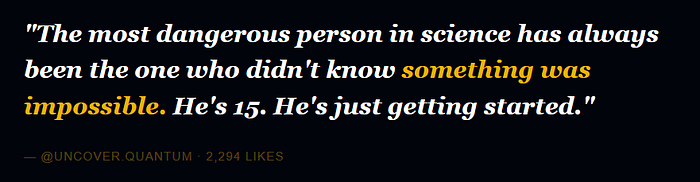
Laurent Simons will almost certainly not create superhumans by himself, in the way that phrase is commonly understood. What he might do working at the intersection of quantum physics, AI, and biology, at a level of mathematical sophistication that very few people in any field can match is contribute to the incremental, compounding work that eventually makes certain things possible that weren't before. That is how science actually works. The dramatic breakthroughs are built on thousands of unspectacular contributions, most of which are made by people who quietly knew what was impossible and quietly proved it wasn't.
He's 15. He finished high school at 8. His PhD thesis is on Bose polarons in quantum superfluids. His next thesis is about defeating aging. He's just getting started.
I'm going to go back to studying algorithms now. I have an exam next week.
Laurent Simons' PhD thesis "Bose polarons in superfluids and supersolids" was publicly defended at the University of Antwerp on November 17, 2025, and is documented in university records. His second PhD program at the University of Munich is ongoing. Reporting sources: Daily Galaxy, ScienceAlert, Earth.com, The Print, Futura-Sciences, Indian Defence Review, VnExpress International.

This story is published on Generative AI. Connect with us on LinkedIn and follow Zeniteq to stay in the loop with the latest AI stories.
Subscribe to our newsletter and YouTube channel to stay updated with the latest news and updates on generative AI. Let's shape the future of AI together!
